Israel's Knesset Stalls as Netanyahu and Eisenkot Fail to Secure Majority
Neither bloc has the 61 seats needed to rule, forcing a complex negotiation process that could extend for months.
By Neha Kapoor ·
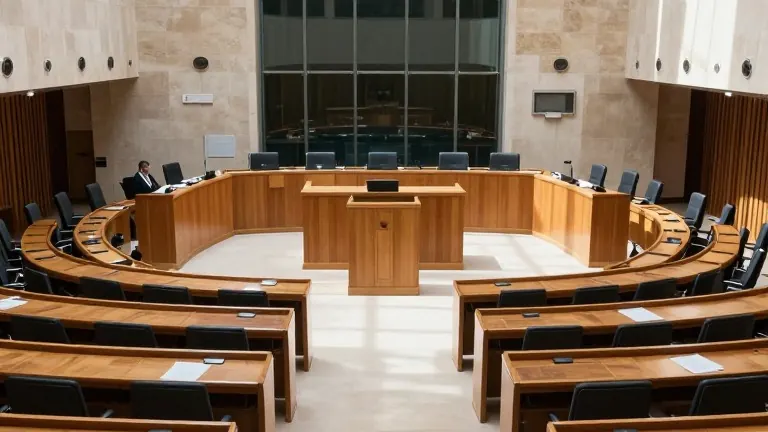
Israel's parliament is in a stalemate following the recent general election.
The final vote counts left both Prime Minister Benjamin Netanyahu and his chief rival, Gadi Eisenkot, short of the governing majority required to form a cabinet. Neither leader commands the 61 seats needed in the 120-seat Knesset.
Netanyahu's Likud party secured the highest number of individual votes, but his right-wing, far-right, and ultra-Orthodox coalition partners fall below the threshold. Eisenkot, a center-right former military chief of staff, holds more seats in his bloc but lacks the numbers to rule without support from predominantly Arab parties.
The political deadlock centers on a specific constraint. Eisenkot's allies ruled out governing with Arab-led parties during the campaign. Those parties represent 21% of the population and have shown divided stances on the war in Gaza and the status of Hamas. Eisenkot argues their positions on the military conflict prevent a stable partnership.
Israel's president will now consult with all elected party leaders in the coming days. The president will select the candidate deemed most likely to assemble a coalition, a role that is not automatically given to the leader of the largest party. The chosen candidate has 28 days to secure support from at least 61 lawmakers. An extension of up to 14 days is possible if the initial deadline passes without a deal.
Several paths to a government exist, though each faces hurdles. Reports indicate President Trump favors a unity government between Netanyahu and Eisenkot, a move that could facilitate regional cooperation on Gaza reconstruction and Saudi normalization. However, Eisenkot has pledged not to serve under Netanyahu, and the two must resolve questions regarding who holds the prime ministerial title.
An alternative scenario involves Eisenkot forming a minority government supported from outside the coalition by Arab parties. This arrangement would yield a parliamentary majority of more than 67 seats but contradicts campaign promises. A third option is a repeat election, which Netanyahu may prefer if he believes Arab turnout will decline or liberal overseas voters will stay home.
Defection is another theoretical route, though it appears unlikely given the seat distribution. Netanyahu would need roughly eight lawmakers from outside his bloc to reach a majority. Eisenkot would need approximately 13 defectors if he continues to exclude Arab parties from the cabinet.
The opposition may leverage the waiting period to advance legislative changes. Eisenkot's bloc is considering replacing the speaker of the Knesset to control the legislative agenda. They also aim to pass a state commission of inquiry into the failures preceding the October 7, 2023, Hamas attack. These moves allow opponents to exert influence while coalition talks drag on.
External conflicts could accelerate the process. Netanyahu stated in his election night speech that Israel must complete its mission against Iran. Analyst Danny Citrinowicz noted that Netanyahu has a political incentive to renew fighting during the negotiation period. Such an emergency would increase pressure on Eisenkot to join a unity government, a dynamic similar to the period following the October 7 attack.
Source: WPGH? WPXI? WESA