Fifth Round of Protests Sweeps France Amidst Political Tension
Tens of thousands of demonstrators took to the streets across France on Saturday for the fifth consecutive week, challenging government policies on police powers and the rising cost of living.
By News Media House Staff ·
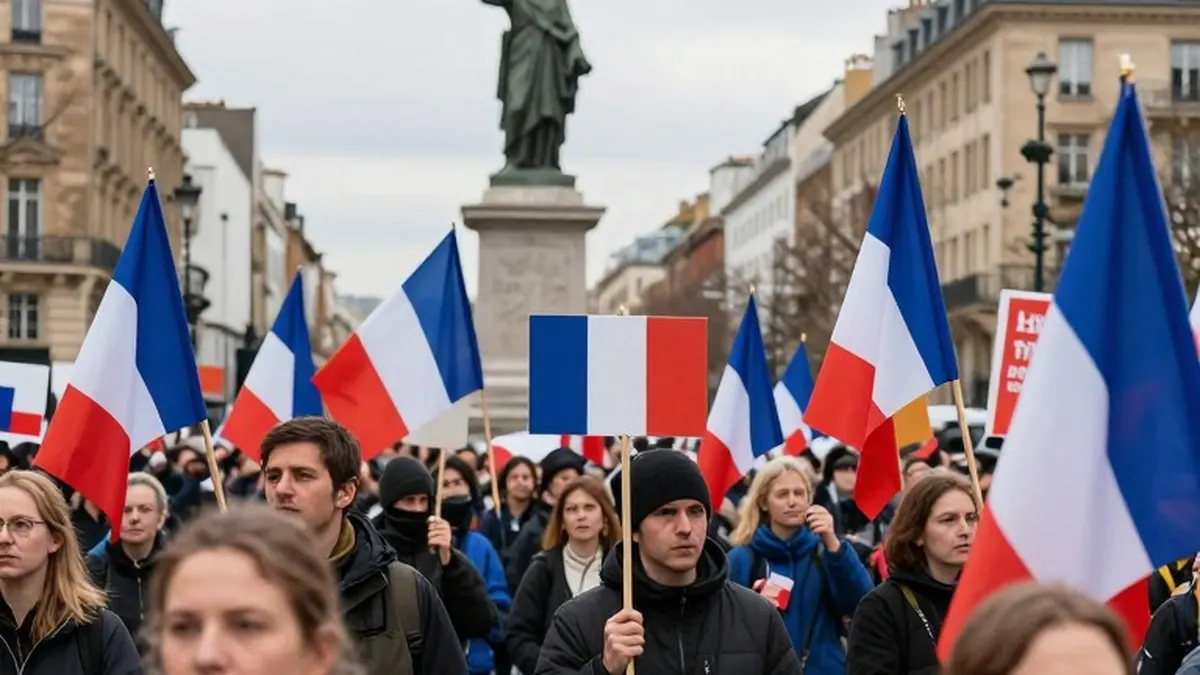
France experienced its fifth consecutive weekend of mass demonstrations on Saturday, with estimates of the turnout ranging significantly between official government figures and student union counts. The interior ministry reported that approximately 106,000 people participated nationwide, including 24,000 in Paris, marking the lowest attendance in recent weeks. In contrast, student unions claimed the number of demonstrators reached 200,000, with nearly 100,000 gathering in the capital.
The protests, which have continued for over a month, saw tens of thousands of people marching through city streets. Some participants climbed statues while waving French flags, expressing frustration over issues such as the increasing cost of living and a proposed legislative change to grant police greater legal protection. The mood was charged but largely peaceful, with slogans like 'No justice, no peace' echoing through the crowds.
The central focus of the day was a new bill currently in parliament that aims to provide additional legal protection to police officers who use their weapons. Supporters of the measure, including the far-right party led by Marine Le Pen, argue that a presumption of self-defense is necessary to prevent officers from being automatically suspected of using disproportionate force. Critics, however, contend that the bill functions as a 'licence to kill' by making it harder to open investigations and hold security forces accountable in a country where police brutality cases rarely result in criminal trials.
Arrest figures were notably lower than in previous rounds of protests. The ministry stated that 219 people were detained across the nation, while Paris prosecutors reported 45 arrests in the capital alone. Despite the lower number of detentions, incidents of fringe violence and accusations of police brutality, particularly against young teenagers, have been reported in recent weeks. Lawyers noted that police actions at recent demonstrations have led to significant injuries, including damage to hands, feet, and eyes.
Adrien, a 20-year-old cello player participating in a volunteer orchestra at the Paris rally, highlighted the fear many protesters feel. He stated that the new bill would only intensify their anxiety regarding police impunity, especially after tear gas was used on protesting musicians the previous month. 'We are scared when we come to a protest, and this will only make us even more afraid if their impunity is strengthened,' he said.
The political landscape in France remains volatile, with President Emmanuel Macron's popularity at its lowest point since his inauguration in 2017. Recent polls suggest that the far right is leading in the race for next year's presidential elections, with hard-left candidate Jean-Luc Melanchon projected as the runner-up. The government faces limited options for responding to protester demands as it struggles to manage national debt.
In the southwestern city of Bordeaux, 72-year-old Josette expressed gratitude to the younger generation for initiating the movement. She described the youth as giving hope during a time of perceived disaster, citing a warming planet and increasingly unapologetic far-right movements as key concerns. In the southern city of Toulouse, Kenza, a 28-year-old asylum law specialist, criticized the government's handling of the unrest, stating that the repression of protesters was unacceptable, particularly when children were involved.
Local authorities in Lyon reported that police had to intervene to protect a team of television reporters after they were attacked by protesters. Meanwhile, across the country, demonstrators called for better learning conditions and enhanced children's rights. In one instance, a group in Paris carried a giant puppet with a hat reading 'Lord Macron,' while others chanted for the president's resignation.
Unions have announced plans for a new day of strikes on Tuesday after rejecting a government promise to raise the minimum wage by 0.6 percent, describing the increase as mere 'crumbs.' This follows a significant union-led strike last Thursday, when official figures indicated that more than half a million people took to the streets nationwide, representing the largest turnout in recent weeks.
The ongoing demonstrations highlight the deepening social unrest in the European Union's second-largest economy. As high-school blockades and mass protests continue, the pressure on the government to address economic and security concerns appears to be mounting ahead of the upcoming presidential elections.
Originally published by News Media House