EU Naval Force Adds New Patrol Layer as Somali Piracy Spikes
Seven hundred attacks have occurred since late 2023, prompting the European Union to reinforce its anti-piracy operations in the Gulf of Aden.
By Neha Kapoor ·
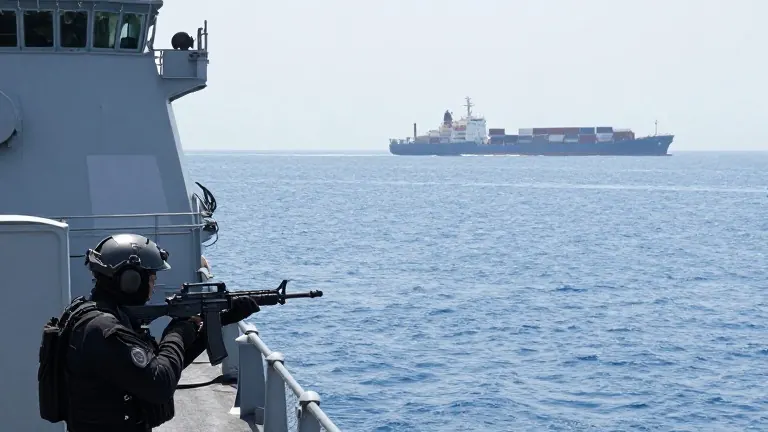
The Associated Press joined a European Union naval patrol in the Gulf of Aden this week, providing a rare look at the intensified security measures deployed against a resurgence in maritime piracy. The mission, known as Operation Atalanta, is currently led by the Spanish frigate Santa Maria, which patrols the western Indian Ocean and the strategic Bab el-Mandeb Strait.
Onboard the 4,000-ton warship, Spanish special forces conducted live-fire exercises on the deck. Petty officers commanded the drill as soldiers in body armor and face wraps emptied clips from pistols and machine guns at targets. These drills prepare crews for the possibility of seizing vessels captured by pirates, a threat that has grown alongside regional conflicts in Yemen, the Horn of Africa, and Iran.
The Bab el-Mandeb is a narrow chokepoint, less than 30 kilometers wide, where approximately 12% of global trade and a quarter of container traffic normally move between Asia and Europe. Its importance has increased further as the Strait of Hormuz has been disrupted by the ongoing Iran war, making the Bab el-Mandeb a critical alternate route for oil exports from the Gulf.
Since the Houthis began attacking shipping in the region in November 2023, commanders count 79 pirate attacks. Portuguese Commodore Jose Rodrigues Pedra, the current commander of the Atalanta mission at sea, noted that roughly 30 of these incidents occurred after the outbreak of the Iran war in February. He described the relationship between the crises as cumulative, stating that crisis creates crisis.
The mission operates from a French military base in Djibouti, using surveillance planes equipped with radar and advanced cameras to monitor the sea. Intelligence is shared with military deployments from the United States, South Korea, Japan, India, and other European nations. The EU also maintains a second naval force, Operation Aspides, which focuses specifically on the Red Sea and deploys more ships.
Analysts attribute the return of Somali piracy to economic malaise, political impasse, and civil strife. The United Nations reported in February that around 30% of the Somali population faces critical food insecurity. Pirates based in the semiautonomous region of Puntland have seized fuel tankers and even a Turkish ship carrying weapons. A new tactic involves pirates attacking off the Yemeni coast before moving ships toward Somalia.
The Associated Press tracked six commercial vessels hijacked between April and August of this year. Five were freed, but the MT Asana, a Tanzanian-flagged tanker captured in July, remained under pirate control as of an Oct. 16 update. The International Maritime Organization reported that 22 seafarers were still captive on that vessel earlier this month.
Retaking ships remains dangerous. Five crew members died during the September operation to recover the tanker Honour 25, which had been held since April. The International Maritime Organization confirmed that 44 seafarers were freed from that vessel and two other tankers, the Eureka and the Sibu 1. In early November, Indian forces freed an Iranian fishing vessel after a 48-hour operation.
Shipping companies are responding by rerouting vessels and increasing security costs. Christopher Hockey, a fellow at the Royal United Services Institute, noted that piracy benefits the Houthis and Iranians by disrupting traffic. He warned that vessels without armed security teams are the primary targets. Meanwhile, the Houthis have approached some companies to offer protection services for passage through the strait.