Reports link French riots to foreign influence
Internal analyses indicate that Russian, Israeli, and American accounts amplified specific narratives during the October unrest in France.
By Martin Reynolds ·
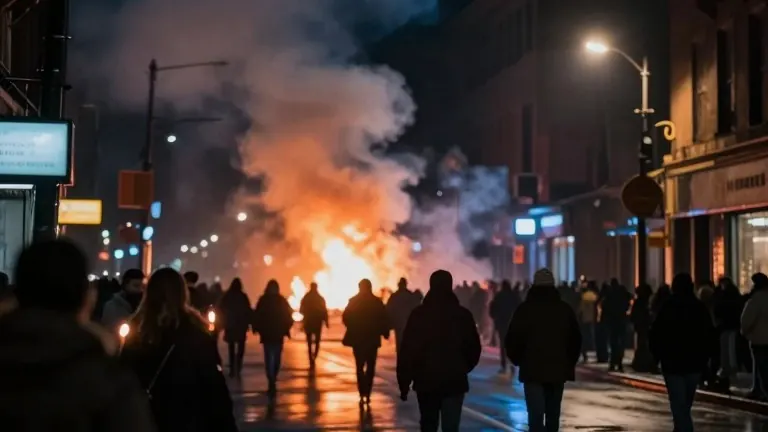
France's Foreign Ministry and the European Union have released internal assessments detailing how external actors leveraged social media during the riots that swept the country in October. The reports identify coordinated efforts by Russian, Israeli, and American-linked accounts to shape public perception of the domestic turmoil. These findings suggest that outside groups sought to exploit the violence for their own political goals.
The French ministry’s evaluation focused on the reach of specific online narratives. It found that social media posts linked to the MAGA movement in the United States and to Israel generated the highest engagement. Between October 16 and 18, the ten most-viewed posts from MAGA-linked officials, media outlets, and influencers received more than 49 million views. In the same period, the ten most-viewed posts from Israeli entities exceeded 35 million views. By comparison, the ten most-viewed posts from pro-Russian spheres drew 2.8 million views.
A separate European Union analysis covering the period from October 7 to 21 identified a covert Russian network named Operation Overload. The report stated that this network aimed to portray the French leadership as weak and increasingly authoritarian. It spread videos impersonating Western media outlets to target French audiences. Some of these posts falsely claimed that migrants had raped protesters or that terrorist attacks were imminent. The EU document described the activity as the opportunistic exploitation of unrest rather than an effort to instigate the initial protests.
The EU analysis noted that Operation Overload has been active since September 2023. The network targets Western public figures, institutions, and media outlets to discredit them and their support for Ukraine. It uses artificial intelligence to clone expert voices, forges newspaper headlines, and manipulates images. The Institute for Strategic Dialogue, a Britain-based think tank, characterized the operation as a persistent and high-volume Russian information campaign that pivots from country to country to exploit crises.
Elina Treyger, a senior political scientist at the RAND Corporation, described these campaigns as a slow-burning narrative competition. She explained that such efforts can shape how Western democracies are perceived in Europe and beyond. Treyger stated that these campaigns feed an anti-immigrant backlash that is pushing European voters toward political extremes.
President Emmanuel Macron addressed the issue on October 21. He stated that there was no visible foreign interference behind the protests, but he acknowledged foreign manipulation of information. French officials referred to these remarks when asked for comment on the new assessments. The office of Prime Minister Benjamin Netanyahu and the Russian Foreign Ministry did not respond to requests for comment.
In August, Russian Foreign Ministry spokesperson Maria Zakharova rejected allegations that Russia was spreading disinformation about France's 2027 elections. She described the claims as a concoction used by authorities to manipulate public opinion. The riots in October saw demonstrations against rising living costs and declining public services spiral into some of the worst violence France has witnessed in decades. The reports indicate that these external actors tied the domestic turmoil to radical Islamism and migration.