Voyager 1 Hits One Light-Day Mark in Interstellar Space
NASA’s oldest spacecraft will mark a new distance record on Wednesday, having traveled more than 16 billion miles since launch.
By Martin Reynolds ·
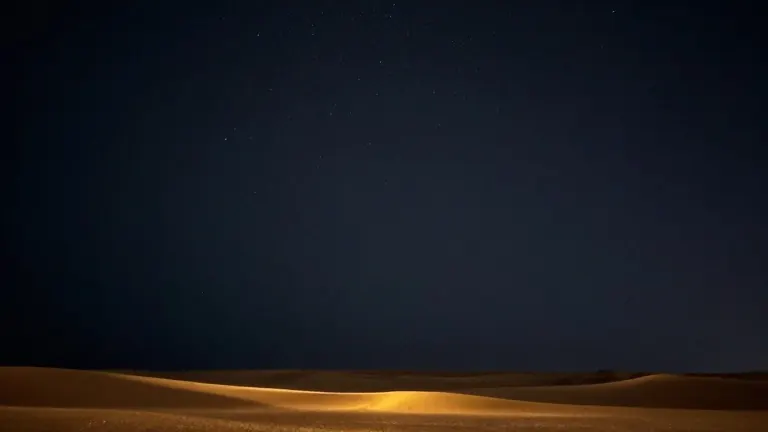
NASA’s Voyager 1 will reach one light-day from Earth on Wednesday, becoming the first human-made object to travel that far from the planet.
The distance exceeds 16 billion miles. At that point, radio signals from the spacecraft will take exactly 24 hours to reach Earth at the speed of light.
Project manager Suzanne Dodd described the probe as Earth’s ambassador between stars. She told The Associated Press that the spacecraft is a national treasure and really extraordinary.
Voyager 1 launched in 1977. It passed Jupiter in 1979 and Saturn in 1980. The probe exited the solar system and entered interstellar space in 2012.
Its twin, Voyager 2, launched two weeks earlier. Voyager 2 visited Jupiter, Saturn, Uranus, and Neptune. It entered interstellar space in 2018. Voyager 2 will reach the one light-day mark in 2035.
Both spacecraft travel at 38,000 mph. They send data on magnetic fields, pressure, dust, and cosmic rays almost every day.
Dodd, who has worked with the missions since 1984, compares them to weather satellites. A small team at NASA’s Jet Propulsion Laboratory in Pasadena sends commands about once a week.
The team sometimes calls on retirees from the original project for help. In September, controllers performed a power-conserving update on the plutonium-powered craft. In October, contact was briefly lost. Engineers are still determining why the communication disruption occurred.
In 1990, Voyager 1 took the famous Pale Blue Dot image from beyond Neptune. Carl Sagan, part of the imaging team, described Earth as a small stage in a great cosmic arena. He died in 1996.
Bill Nye of the Planetary Society said in a statement that everyone on Earth has been touched by these missions. The society, co-founded by Sagan in 1980, supports the public’s connection to the probes.
Each Voyager carries a 12-inch gold-plated record. It includes greetings in 55 languages, images, and diagrams. Sagan recorded his then six-year-old son Nick saying hello from the children on Planet Earth. A stylus and instructions are included for potential finders.
Dodd called the record a time capsule of life on Earth from 1977. She said she hopes someone finds it 1,000 years from now.