Beirut Artists Turn War Debris Into Sculpture and Paint
Abdul Rahman Katanani and Ayman Baalbaki use scrap metal and thick acrylic layers to document the destruction of their cities.
By Martin Reynolds ·
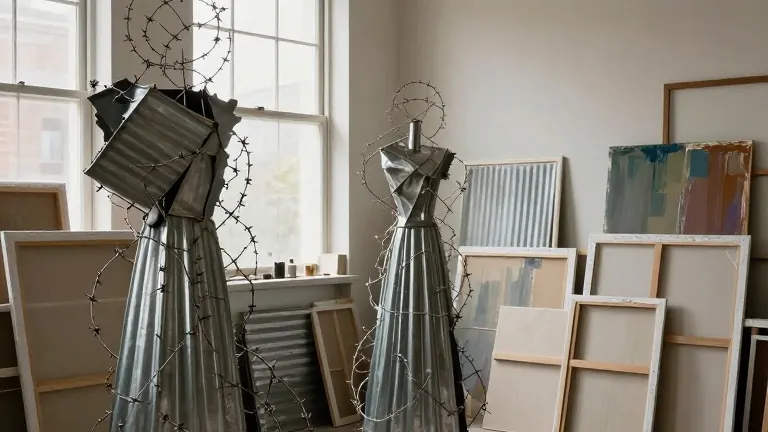
In a quiet village high in the hills outside Beirut, Abdul Rahman Katanani builds large-scale sculptures from the physical remnants of his childhood. His studio is filled with barbed wire, corrugated metal, and discarded clothes gathered from the Sabra and Shatila refugee camp in Beirut. These materials form a nine-meter wave of twisted wire, a lotus flower, and a replica of a camp room. Katanani, who was born eight days after the 1982 massacre at that camp, describes the objects as the shadows of his people. He now lives in this studio with his mother, twin brothers, their daughters, and two cats.
Across the city, in a building in central Beirut, Ayman Baalbaki works on massive mixed-media paintings. His pieces feature thick layers of acrylic in intense colors, depicting the ruins of Beirut. One notable work from 2015 and 2016 shows the Barakat Building, an Ottoman-style structure that stood on the Green Line during the 15-year civil war. The building, now a museum, retains bullet holes in its sandstone arches. Baalbaki’s other series, titled Al-Mulatham, shows veiled men against backgrounds of bright floral fabrics from southern Lebanon.
The two men have known each other for more than a decade, though they first met while working with the same gallery. Their backgrounds differ. Baalbaki is part of a family of artists from Odaisseh, a village on the border with Palestine. He studied in Paris for three years at two elite art colleges. His grandfather’s home was destroyed during Israeli attacks in 1979, and his father, Fawzi Baalbaki, lost many paintings to destruction or theft during the war. Katanani, a Palestinian, grew up in a damaged former hospital in Shatila. He worked as a porter for his carpenter father and drew caricatures for the camp residents.
Both artists faced isolation during their youth. Katanani said the camp bred a psychological sense of seeing outsiders as enemies. He eventually left after a French delegation saw his drawings, leading to exhibitions in Europe and a residency in Paris. Baalbaki spent the civil war years in Wadi Abu Jamil, a Jewish area that became a front line between militia groups. He lived between four ruined buildings during that period. The shared history of violence in the region includes six Israeli attacks on Lebanon, an 18-year occupation of the south, and a 29-year Syrian military presence. At least 17,000 people from the region remain missing.
The artists were together in Egypt on October 7, 2023, when Hamas launched an attack and Israel began its war in Gaza. Katanani lost 15 family members in Gaza. Both men described feeling paralyzed by the events. Katanani entered a deep depression, while Baalbaki says the feeling of paralysis continues, making work a form of resistance. They have since traveled to residencies in Morocco and Latin America. Baalbaki cites Diego Rivera’s work in Mexico as a life-changing influence on his vision. Katanani spent 15 months at the Cite Internationale des Arts in Paris, where he questioned his identity as an artist.
Their work is currently displayed in museums and private collections worldwide. Rose Issa, a Lebanese-French curator, has known both men for many years. She describes them as exceptional people with extreme generosity of mind and talent. Their studios remain hubs for their families and artistic processes, preserving the memory of conflict through physical form and color.