Hawaii nonprofits distribute millions in aid after spring storms
Local groups provided rapid relief and long-term recovery support following Kona low storms that caused an estimated $1 billion in damage.
By Jillian Foster ·
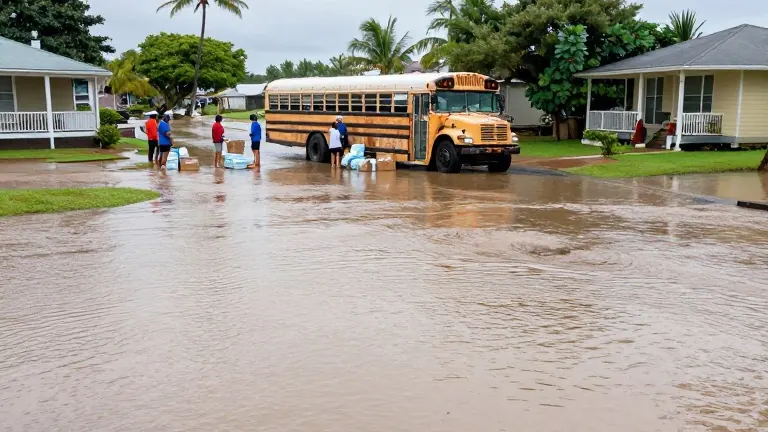
Kona low storms brought torrential rain to Hawaii in March, causing an estimated $1 billion in damage.
Local nonprofits moved quickly to provide emergency supplies, medical care, and financial assistance to residents in hard-hit areas.
Melissa Ka'onohi-Camit, a special education teacher in Kahuku with 27 years of experience, checked on her family and then drove a rusted school bus to assist neighbors.
Ka'onohi-Camit is a founder of the La'hui Foundation, a small nonprofit that sprang into action during the flooding.
The Hawaii Community Foundation activated its Stronger Hawaii initiative, building on lessons learned from the Lahaina fires.
The foundation awarded nearly $1.54 million to 16 organizations to support more than 8,400 individuals, according to Keanu Lau Hee, the organization's vice president of community resilience.
Lau Hee said local organizations respond to obvious needs without waiting for external direction.
She noted that government agencies often move slower due to procurement laws, whereas community groups can act with less red tape.
The foundation helps communities through four phases: risk reduction, rapid response, recovery, and rebuilding resilience.
The La'hui Foundation was launched in 2019 by five community members who felt residents' voices were not being heard.
Ka'onohi-Camit described the group's origins as four moms and one man.
During the March storms, the group focused on reaching rural Ko'olauloa communities connected by Kamehameha Highway, as they did after the 2021 floods in Hau'ula when they rescued an elderly resident who had been on the ground for two days. Ka'onohi-Camit called this duty part of their journey in life. The La'hui Foundation is part of the Ko'olau Resilience Hub Network, established in 2024 by Vibrant Hawaii. This network includes 15 nonprofit and community-based organizations serving Windward Oahu communities. Rainbow Uli'i-Akina, executive director of KEY Project, noted that the network served as a trusted first layer of response. In March, KEY Project and four partners distributed $42,000 in Foodland gift cards to more than 150 families while rain was still falling. The state distributed $175 million in aid and sought federal assistance. The Office of Hawaiian Affairs and the Hawaiian Council provided a community-based recovery hub on the North Shore after the city's center closed. In late August, the Office of Hawaiian Affairs reported that more than $1.5 million in assistance had been distributed or approved for Native Hawaiian beneficiaries. The I Ola: Kona Low Disaster Relief program approved assistance to 130 people and disbursed nearly $1.1 million statewide. The Mahi'ai Microfund distributed $101,000 to 21 agricultural beneficiaries, with another $89,000 pending. The Ina'i Kokua Gift Card Program distributed 190 Home Depot gift cards totaling $380,000. Ninety-seven cards were delivered on Oahu, 29 on Hawaii Island, 31 on Maui, and 33 on Molokai. In August, the Office of Hawaiian Affairs board voted to redeploy the program's remaining $30,407 to Kokua Kau to assist with Hurricane Lala response. The Holomua Collective gave $580,000 through its Waialua-Hale'iwa Homeowner Recovery Grant Program. This provided $10,000 each to 58 families for immediate needs. Holomua board chair Mike Pietsch rallied his company, local banks, and philanthropists to fund repairs, materials, and insurance deductibles. Wahiawa Health deployed its mobile health bus to Waialua, the hardest-hit area. CEO Bev Harbin said the center mobilized the bus to provide emergency medical care after the Department of Health confirmed harmful bacteria in mud samples. The bus parked on the campus of Waialua Elementary School. Community donations also replaced band instruments and uniforms lost when Kona lows flooded parts of Kahuku High and Intermediate School. Ka'onohi-Camit said the foundation can see the impact it makes because it is neighbors helping neighbors.