Oleshky aid convoy ready as localized truce enters third day
Humanitarian supplies will enter the besieged southern Ukrainian city on Friday, while a separate drone strike in Dnipro killed at least 14 people.
By Jillian Foster ·
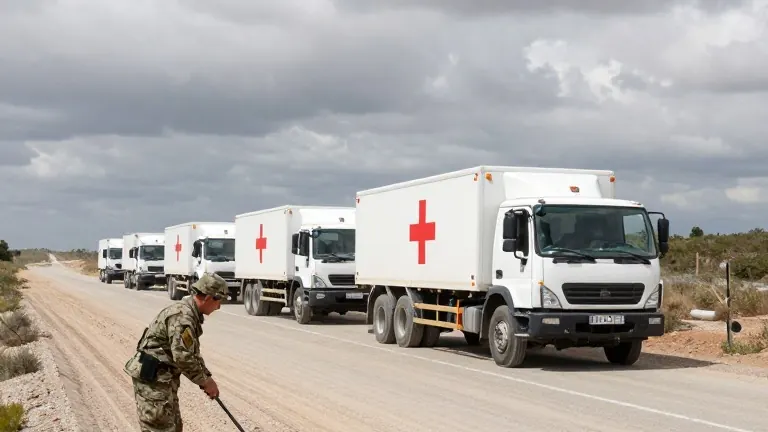
Residents in and around the southern Ukrainian city of Oleshky will see a shift in daily life on Friday as a humanitarian convoy rolls into the area. The delivery marks the first major aid movement under a localized ceasefire that has held for three days. The pause in fighting is allowing military engineers to clear landmines from designated routes, creating a safe path for food and medical supplies to reach approximately 2,000 trapped civilians.
The truce took effect on Tuesday. Negotiators from Moscow and Kyiv began coordinating the entry of aid vehicles as the war entered its fifth year. Previous attempts at local ceasefires often collapsed quickly, but both sides reported strict adherence to the current agreement through Thursday. No violations have been reported in the Oleshky sector.
Dmytro Lubinets, Ukraine’s ombudsman and head of the negotiating team, confirmed that the demining process is complete. He stated that the convoy is assembled and ready to depart. His Russian counterpart, Yana Lantratova, agreed that both sides are honoring their commitments. She noted that Russian engineers are actively clearing roads to ensure the convoy can pass without incident.
The stillness in Oleshky contrasts with violence elsewhere in Ukraine. A jet-powered Russian drone struck two passenger trains at a station in Dnipro on Thursday. The attack killed at least 14 people and injured 14 others. Among the wounded was a 40-year-old man who required the amputation of both legs. In the northern city of Chernihiv, a Russian cruise missile killed two 15-year-old girls. A separate drone attack on an apartment block in Kremenchuk claimed three civilian lives. Authorities reported 56 total injuries from these strikes, including 10 children.
Russia’s Defense Ministry said its air defenses downed 1,214 Ukrainian drones overnight. Moscow Mayor Sergei Sobyanin stated that about half of those drones were targeting the Russian capital. This was one of the largest drone attacks launched by Kyiv to date. The exchange of fire highlights that the broader war continues despite the local truce in the south.
The current six-day ceasefire was brokered with the help of U.S. First Lady Melania Trump. Both Moscow and Kyiv thanked her for facilitating the arrangement. Pope Leo XIV also called for the truce. Officials said residents of Oleshky will be allowed to leave for either Russia or Ukraine, though the specific logistics for the evacuation have not been detailed. Ksenia Arkhipova, a local volunteer, said roughly 1,000 residents want to leave. She emphasized the need for a Ukrainian delegation to be present to reassure those who fear identification by Russian authorities.
In the nearby Ukrainian-held city of Kherson, the pause in drone attacks allowed people to return to the streets. Nataliia Myronenko, who runs a coffee kiosk, reported a steady stream of customers during lunch and evening hours. She said the break in hostilities offers a temporary sense of relief. "It is a breath of freedom, when you do not look at the sky," Myronenko said. "You keep looking at your feet because of the mines, but you are not afraid of dying."
Ukraine’s central bank issued a warning on Thursday that damage to industrial targets could push the country into a recession. Governor Andriy Pyshnyy said the bank now expects the economy to contract by 0.4% in 2026. This is a downward revision from the 1.8% growth forecast issued in July. The annual inflation projection was raised to 12.5% from 10%. Pyshnyy blamed the economic decline on surging fuel prices and intensified Russian attacks on logistics and production facilities.
Source: The San Bernardino Sun