Breaking: From Record Highs to Rout: Midterm Election Sparks Tech Sell-Off
After a Truth Social boast about record highs, markets crashed as Democratic victories raised concerns over AI data center expansion.
By Neha Kapoor ·
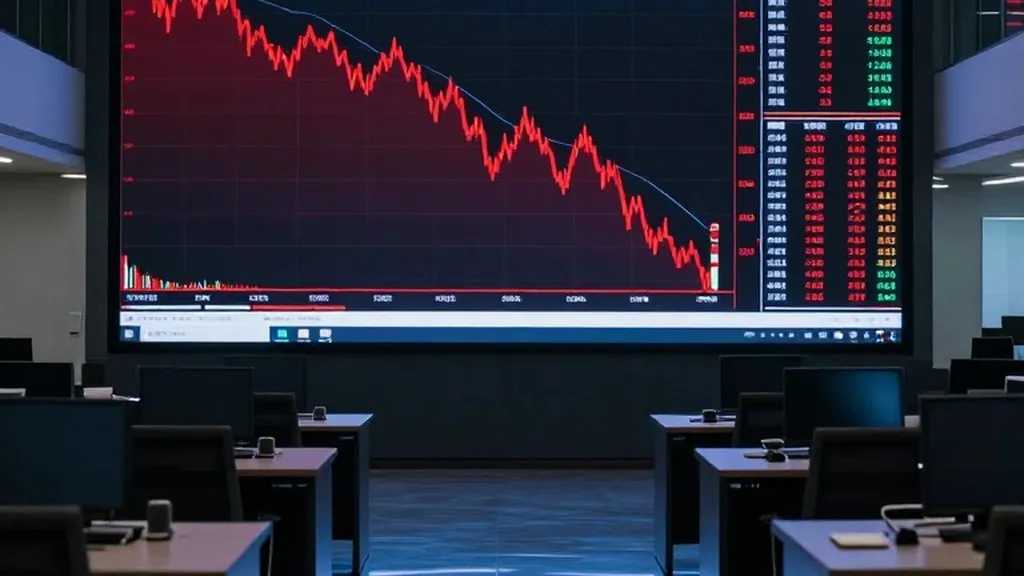
President Trump’s optimistic message on Truth Social on Wednesday, which celebrated a new record high for the stock market, now stands in stark contrast to the trading floor on Thursday. The post, which touted the strength of 401(k) accounts and the market’s performance over the last two years, was issued just before a day that wiped out those gains and more. This sharp reversal highlights the volatile nature of markets during midterm election years, a pattern that has played out repeatedly since 1974. While historical data suggests that markets often recover from such post-election dips, the current environment presents unique challenges for investors who are now grappling with the specific impact of political shifts on the technology sector.
The Dow Jones Industrial Average, which tracks 30 large US companies, fell more than 1,800 points on Thursday, a drop of 3.4 percent to 51,868, according to The Guardian. This decline erased the significant gains made on Wednesday, which had been the Dow’s biggest gain of the year. The S&P 500 fell 4.3 percent, marking its worst day since April 2025 when sweeping global tariffs were announced. The selling spread through every sector of the S&P 500 and gathered pace through the day, as reported by The New York Times. For the average reader, this means that retirement accounts and savings linked to these broad market indices have seen a sudden and significant reduction in value, turning recent highs into a distant memory in a single session.
The Nasdaq Composite, which is heavily weighted toward technology stocks, experienced an even steeper decline of 5.5 percent, its worst day in 18 months. The index closed more than 11 percent below the record it set last month, placing it in correction territory, which is defined as a fall of at least 10 percent from a recent high. An estimated $2.5 trillion in market value was wiped from the Nasdaq Composite, according to Dow Jones data cited by the BBC. The so-called Magnificent Seven technology companies, including Apple, Nvidia, and Tesla, shed about $1 trillion in value in that single trading day. For small investors and savers, this represents a tangible loss in the value of their holdings, particularly if they have concentrated their portfolios in these high-growth tech stocks that have driven much of the recent market rally.
The catalyst for this rout was the Democrats’ sweep of the House and Senate in Tuesday’s midterm elections, as noted by CNBC. Democrats campaigned on slowing the spread of data centers and AI, and voters rejected data center development in a series of local ballots across the country. In Texas, Democrat Gina Hinojosa won the race for governor after campaigning on an immediate moratorium on new data center construction. Investors are now weighing whether these tighter state-level restrictions could slow data center construction, pressuring companies tied to the artificial intelligence trade. This political shift has collided with broader concerns that the huge sums being spent on AI may not pay off, leading to fears that AI shares may be in a bubble.
Chip and AI stocks led the decline, with Nvidia falling 9.2 percent, the biggest faller in the Dow, losing more than $400 billion in market value. SanDisk fell more than 22 percent, and Western Digital fell 17 percent, according to BBC and The Guardian. The Philadelphia Semiconductor Index, which tracks 30 of the largest chip companies, fell more than 12 percent and is almost 40 percent below its peak in June. The iShares Semiconductor ETF (SOXX) fell 12 percent, its worst day since the Covid-19 breakout in March 2020, as reported by CNBC. This sector-specific drop underscores how concentrated the market’s recent gains had been in the AI and chip supply chains, a concentration that has now become a point of vulnerability.
Wall Street’s fear gauge, the Cboe Volatility Index (VIX), jumped as much as 5.7 points to above 28 about 90 minutes after the opening bell, its highest reading since March 31, 2026. The Guardian reported the VIX up 61 percent on the day, and by midday nearly 800,000 VIX call options had traded, 3.5 times the 30-day average, according to Cboe data via CNBC. This spike in volatility indicates that investors are pricing in higher expected turbulence in the coming weeks. The 10-year Treasury yield fell to 4.83 percent, its lowest since September, as investors bought bonds as a haven, a classic move during periods of stock market stress. In London, the FTSE 100 closed down 46 points, or 0.4 percent, at 10,782.66, after an early rally in Europe fizzled, according to The Guardian.
Analysts are offering mixed perspectives on what this day means for the future. Neil Wilson, investor strategist at Saxo UK, described the event as a "complete capitulation-level event" in tech stocks, noting that the fear is a total momentum unwind as Democrats pace the frontier and kibosh datacenter buildout. Dan Ives, a tech analyst, stated that there is no way to sugarcoat that Democrats taking control, especially over the Senate, will create major hurdles for AI and tech legislation in the Beltway over the next two years. Ted Parkhill, founder and chief executive of Incline Investment Management, observed that the market is moving from the promise of AI to the price of AI, suggesting that while AI is transformative, not every AI-related stock is currently priced appropriately. Susannah Streeter, chief investment strategist at Wealth Club, added that fresh panic over the AI trade has hit Wall Street hard, with fears that vast sums poured into AI infrastructure may not deliver the returns investors have been banking on.
Source: BBC News, The Guardian with Reuters, The New York Times, CNBC
More Business · Rip-Off Report · Report a business · Got a Story?